
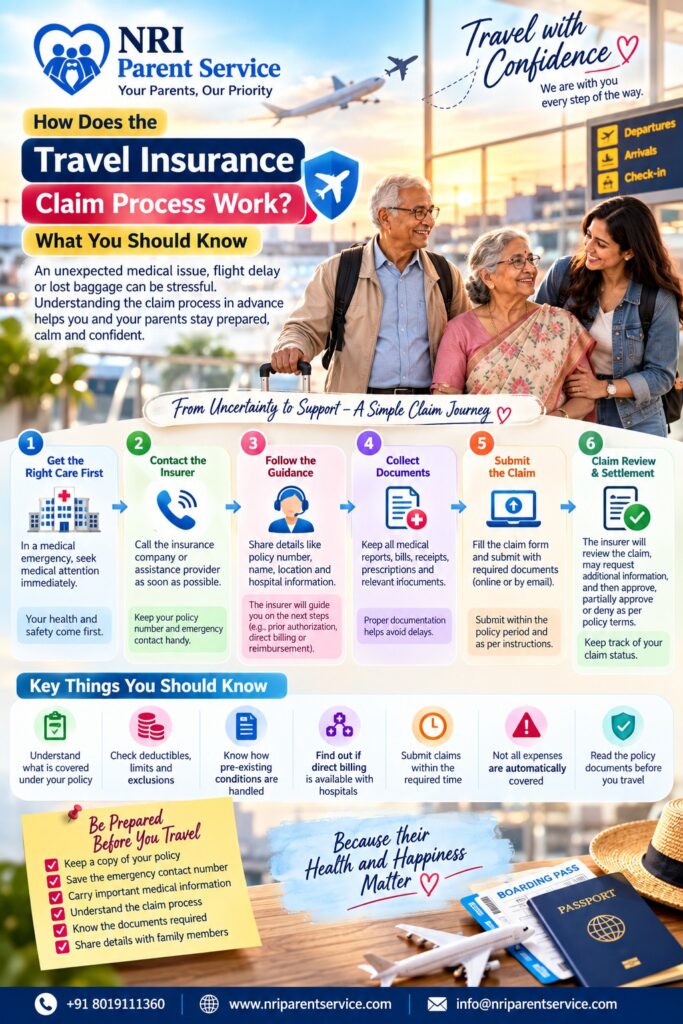
How Does the Travel Insurance Claim Process Work? What You Should Know Before You Need It
Buying travel insurance is only the first step in protecting yourself or your parents during an international journey. The real value of an insurance policy becomes clear when something unexpected happens and you need to make a claim.
For NRI families whose parents are travelling from India to the USA, Canada, UK, Australia or another country, understanding the travel insurance claim process before the journey begins can prevent unnecessary stress later.
Imagine your mother is visiting you abroad and suddenly becomes unwell. She visits a doctor, undergoes diagnostic tests and receives treatment. You have travel insurance, but several questions immediately arise:
Should we contact the insurance company first? Who pays the hospital? What documents are required? Is this treatment covered? How do we submit a claim?
These are exactly the questions families should understand before an emergency occurs.
Here is a simple guide to how the travel insurance claim process generally works and what every traveller should know.
1. First Understand What a Travel Insurance Claim Is
A travel insurance claim is a formal request asking the insurer to provide benefits for an event that is covered under the insurance policy.
Claims are not limited to medical treatment. Depending on the policy, travellers may make claims relating to:
- Emergency medical treatment
- Hospitalisation
- Trip cancellation
- Trip interruption
- Lost or delayed baggage
- Flight delays
- Missed connections
- Emergency medical evacuation
- Other eligible events specified by the policy
The most important words here are “covered under the policy.”
Having travel insurance does not mean every expense that occurs during a trip will automatically be reimbursed.
Every policy has its own coverage limits, deductibles, exclusions, conditions and documentation requirements.
2. What Should You Do When Something Happens?
Suppose your father develops severe abdominal pain while visiting you abroad.
The first priority should always be obtaining appropriate medical attention, particularly when the situation may be an emergency.
Once the immediate situation is under control, check the insurance information and contact the insurer or its assistance provider as soon as reasonably possible.
Many travel insurance policies provide an emergency assistance number.
Keep this number readily available:
Before travelling: Save it on your parent’s phone.
During the journey: Keep a copy with the passport and insurance documents.
For NRI children: Save the policy and assistance details on your own phone as well.
Do not wait until you are standing at a hospital reception desk to start searching through emails for the insurance policy.
3. Contact the Insurance Company or Assistance Provider
When you contact the insurer, you may need to provide information such as:
- Policy number
- Traveller’s name
- Date of birth
- Passport or identification details
- Current location
- Description of what happened
- Hospital or healthcare provider details
- Date of treatment
The insurer or assistance provider can explain the next steps under that particular policy.
For some services, especially planned procedures, certain hospital admissions or medical evacuation, prior notification or authorization may be required under the policy.
This is why reading the policy’s claims and assistance instructions beforehand is important.
4. Cashless/Direct Billing vs. Reimbursement
One of the biggest misunderstandings among travellers is:
“I have insurance, so I don’t have to pay anything at the hospital.”
That is not necessarily true.
Depending on the insurer, healthcare provider, country, policy and circumstances, claims may operate in different ways.
Direct Billing
In some situations, an insurer or assistance provider may coordinate eligible payment directly with a participating healthcare provider.
Even then, the traveller may still be responsible for applicable deductibles, coinsurance, excluded services or amounts outside policy limits.
Reimbursement
In other situations, the traveller may have to pay the healthcare provider first.
The traveller then submits the required documents to the insurance company and requests reimbursement for eligible expenses.
The insurer reviews the claim and determines what amount, if any, is payable according to the policy.
Therefore, always ask:
“Does this provider offer direct billing with my insurer, or do I need to pay and submit a reimbursement claim?”
5. Collect Every Important Document
Documentation is one of the most important parts of an insurance claim.
If you are seeking reimbursement, don’t throw away bills, receipts or medical documents.
Depending on the type of claim, the insurer may request documents such as:
- Completed claim form
- Policy details
- Passport copy
- Visa or travel documents
- Flight itinerary
- Medical reports
- Doctor’s notes
- Diagnosis or treatment records
- Itemised hospital bills
- Pharmacy receipts
- Proof of payment
- Laboratory or diagnostic reports
- Discharge summary
- Prescriptions
For non-medical claims, different evidence may be required.
For example, baggage claims may require airline documentation, while trip-cancellation claims may require proof of prepaid expenses and evidence explaining why the trip was cancelled.
Keep documents until the claim is completely resolved.
6. Submit the Claim Within the Required Time
Insurance policies may specify deadlines for notifying the insurer and submitting claims.
Do not assume you can return to India several months later and then begin collecting documents.
Read the policy’s claim-notification and submission requirements.
Many insurers provide online portals, email submission or other digital claim processes.
Before submitting, verify that:
☑ The claim form is complete
☑ The policy number is correct
☑ Supporting documents are attached
☑ Bills are itemised where required
☑ Proof of payment is included
☑ Contact and payment information is correct
Incomplete documentation can lead to additional requests and delays.
7. What Happens After You Submit a Claim?
Once the insurer receives the claim, it generally enters a review process.
The insurer may examine:
Was the policy active when the event occurred?
Is the event covered by the policy?
Does an exclusion apply?
Was the required procedure followed?
Are the submitted expenses eligible?
What deductible applies?
Does coinsurance apply?
Are there benefit sub-limits?
Was prior authorization required?
The insurer may request additional information from the traveller or healthcare provider before making a decision.
After completing its assessment, the insurer may approve the claim fully, approve part of it, request further information or deny it according to the policy terms.
8. Why Might a Claim Not Be Paid in Full?
This is another area families should understand.
Suppose a medical bill is $5,000.
Having a $100,000 policy maximum does not automatically mean the insurer will pay the entire $5,000.
The final eligible amount may be affected by:
- Deductible
- Coinsurance
- Policy exclusions
- Benefit limits
- Scheduled or fixed benefits
- Provider-network provisions
- Non-covered treatment
- Pre-existing-condition provisions
- Policy maximums or sub-limits
This is why comparing insurance policies only by their advertised maximum coverage can be misleading.
You need to understand how the policy actually pays eligible claims.
9. Pre-Existing Conditions Need Special Attention
This is particularly important when purchasing insurance for elderly parents.
Parents may already have diabetes, hypertension, cardiac conditions, thyroid problems or other chronic health conditions.
Different policies treat pre-existing conditions differently.
Some may exclude them. Others may provide specific or limited benefits under clearly defined circumstances.
Never assume that the phrase “emergency medical coverage” automatically means every emergency related to an existing condition will be covered.
Before travelling, ask the insurer or licensed insurance professional:
“How does this policy define a pre-existing condition, and what benefits or exclusions apply?”
Whenever possible, understand the answer from the actual policy wording rather than relying only on verbal explanations.
10. What If Your Claim Is Denied?
A denied claim does not necessarily mean you should immediately assume the process is over.
First, understand why the claim was denied.
Request or review the insurer’s explanation.
Common reasons may include:
- The expense was outside the policy coverage
- Required documents were missing
- An exclusion applied
- The policy was not active
- A claim deadline was missed
- Prior authorization was required
- The expense exceeded a particular benefit limit
If you believe relevant information was overlooked, follow the insurer’s formal review or appeal procedure and provide supporting documentation where appropriate.
Keep copies of correspondence, claim numbers and documents submitted.
11. What Should You Do Before Your Parents Travel?
The best time to understand a claim is before you need to make one.
Create a simple travel-insurance folder containing:
Insurance policy
Policy/Certificate number
Emergency assistance number
Claim instructions
Insurer contact details
Passport and visa copies
Travel itinerary
Important medical information
Both the travelling parent and the NRI family member should have access to the essential information.
Then ask the insurer these questions:
- How do we report a medical emergency?
- Is direct billing available?
- What deductible applies?
- Is there a provider network?
- Is prior authorization required for certain services?
- How are pre-existing conditions handled?
- What documents are required for reimbursement?
- What are the claim-submission deadlines?
- How do we track a submitted claim?
- What is the process if a claim is denied?
These ten questions can save significant confusion later.
The Golden Rule: Don’t Wait for an Emergency to Read the Policy
Travel insurance should not simply be a PDF stored somewhere in your email.
Understand the important provisions before the journey.
For parents travelling internationally, especially older parents, the family should know:
Who to call → Where to go → What to show → What to collect → How to submit → How to follow up.
Insurance cannot prevent an unexpected event from occurring.
But understanding how the insurance works can make it much easier to respond calmly and systematically when something does happen.
NRI Parent Service – Helping Families Prepare Better
When parents travel abroad, the journey involves much more than booking an airline ticket.
It may involve:
Visa → Flight → Medicines → Travel Insurance → Airport Assistance → Travel Companion → Healthcare Planning → Emergency Preparedness → Safe Return
At NRI Parent Service, our goal is to help NRI families understand and coordinate their parents’ travel and care requirements so they can be better prepared.
Our message to every NRI family is simple:
Don’t wait until your parent is standing at a hospital reception desk to understand the insurance claim process.
Know the policy, keep the documents ready and understand whom to contact before the journey begins.
Because when your parents travel thousands of kilometres to be with you, preparation can bring peace of mind to both generations. ❤️
NRI Parent Service
Your Parents, Our Priority 💙
📞 +91 8019111360
🌐 www.nriparentservice.com
✉️ [email protected]