
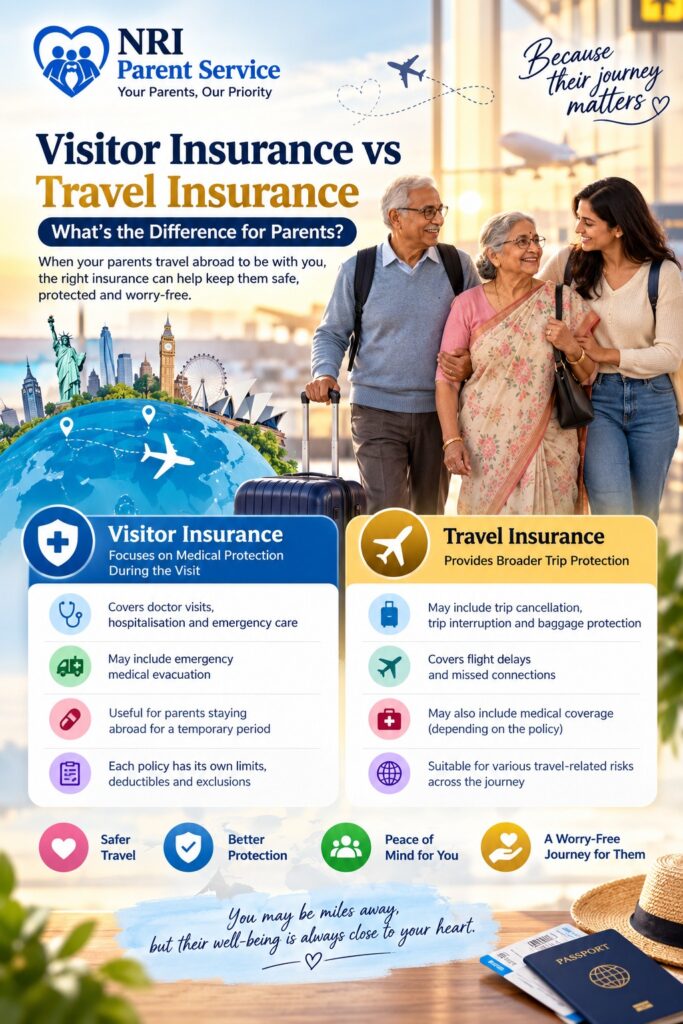
Visitor Insurance vs. Travel Insurance for Parents: What Is the Difference?
When parents travel abroad to visit their children, whether to the USA, Canada, UK, Australia or another country, families usually spend considerable time planning flights, visas, medicines, accommodation and airport assistance. However, one important area is often confusing: insurance.
Many NRI families ask:
“Should I buy visitor insurance or travel insurance for my parents?”
The terms may sound similar, and insurers sometimes use them differently. However, there can be important differences in what a particular policy is designed to protect.
For elderly parents, understanding those differences is especially important because medical expenses during an overseas stay can become a significant financial concern.
Let us understand visitor insurance and travel insurance in simple terms.
What Is Travel Insurance?
Travel insurance is a broad category of insurance designed to protect travellers against certain financial risks associated with a trip.
Depending on the policy selected, travel insurance may include benefits relating to:
- Trip cancellation
- Trip interruption
- Flight delays
- Missed connections
- Lost or delayed baggage
- Emergency medical treatment
- Emergency medical evacuation
- Repatriation
- Accidental injury or death
However, not every travel insurance policy provides all these benefits, and the coverage limits can vary considerably.
For example, one travel insurance plan may focus heavily on trip cancellation and baggage protection while providing relatively limited medical benefits. Another may offer stronger medical coverage.
Therefore, families should never assume that simply purchasing something called “travel insurance” automatically provides adequate medical protection for their parents.
The actual policy benefits, limits and exclusions are what matter.
What Is Visitor Insurance?
Visitor insurance is commonly used to describe short-term insurance for someone temporarily visiting another country.
For example, suppose parents are travelling from India to stay with their son or daughter in the USA for four months. During that period, one of the family’s biggest concerns may be:
“What happens if my parent unexpectedly becomes sick or gets injured while staying abroad?”
Visitor insurance—particularly visitor medical or travel-medical insurance—is generally designed with this type of concern in mind.
Depending on the specific policy, eligible benefits may include:
- Doctor consultations
- Urgent care
- Emergency-room treatment
- Hospitalisation
- Diagnostic tests
- Prescription medicines associated with a covered event
- Ambulance services
- Emergency medical evacuation
- Repatriation
Again, these are not guaranteed benefits in every visitor insurance policy. Coverage depends entirely on the policy terms.
This is why families should pay more attention to the policy document than to the name of the insurance product.
What Is the Main Difference?
In simple terms:
Travel Insurance = Broader Trip Protection
It may protect against several risks associated with travelling, such as cancellation, interruption, baggage loss, delays and medical emergencies.
Visitor/Travel-Medical Insurance = Greater Focus on Medical Protection During the Visit
It is commonly considered when someone is temporarily staying in another country and unexpected healthcare expenses are a major concern.
However, there can be considerable overlap.
Some travel insurance policies provide strong medical coverage, while some visitor policies may include additional travel-related benefits.
Therefore, rather than asking only:
“Is this visitor insurance or travel insurance?”
Ask:
“What exactly does this policy cover for my parents?”
Why Is This Important for Elderly Parents?
Consider a simple example.
Your 68-year-old mother and 72-year-old father travel from India to the USA to stay with you for five months.
You purchase a travel insurance policy because it includes flight cancellation, baggage loss and trip-delay benefits.
Two months after arriving, your father unexpectedly develops a medical problem and needs medical evaluation.
At this point, baggage coverage is not your primary concern.
You need to know:
Is this medical condition covered?
What is the medical coverage limit?
What deductible applies?
Does the insurer use a healthcare provider network?
Is hospitalization covered?
Does the policy have restrictions related to pre-existing conditions?
Will the insurer pay the provider directly, or must you pay first and claim reimbursement?
These questions demonstrate why insurance for elderly parents should not be selected simply by comparing premiums.
What About Pre-Existing Medical Conditions?
This is one of the most important areas to understand when purchasing insurance for parents.
Many elderly travellers may already be managing conditions such as:
- Diabetes
- Hypertension
- Thyroid disorders
- Heart-related conditions
- Arthritis
- Other chronic medical conditions
Having a pre-existing condition does not automatically tell you whether a future medical expense will or will not be covered.
Each insurance policy has its own definition, eligibility requirements and exclusions.
Some policies may exclude treatment associated with pre-existing conditions. Others may provide limited benefits for certain acute or unexpected situations, subject to very specific conditions.
Therefore, never rely only on statements such as:
“Pre-existing conditions are covered.”
Instead, ask:
“How does this specific policy define a pre-existing condition, and what exactly is covered or excluded?”
Read the relevant policy wording carefully.
Understand the Deductible
Another important term is deductible.
A deductible is generally the amount an insured person must pay toward eligible expenses before certain insurance benefits begin, subject to the policy terms.
For example, if a policy has a $500 deductible, the insured person may have to pay the applicable deductible before insurance begins sharing eligible expenses.
However, this does not necessarily mean the insurer will pay 100% of everything after $500.
Coinsurance, policy maximums, network rules, sub-limits and exclusions may still apply.
Therefore, when comparing two policies, don’t compare only:
Policy A – $100,000 coverage
versus
Policy B – $100,000 coverage
You also need to understand how that $100,000 policy maximum actually works.
Fixed-Benefit vs. Comprehensive-Type Insurance
Families researching visitor insurance may also encounter fixed-benefit and comprehensive-type plans.
A fixed-benefit or scheduled-benefit plan generally pays predetermined amounts for eligible medical services according to the policy’s benefit schedule.
If the actual hospital bill is higher than the scheduled amount, the insured person may be responsible for the remaining eligible cost.
A comprehensive-type plan generally works through a deductible and then an eligible-expense sharing structure, subject to policy maximums, coinsurance, network rules and other terms.
For elderly parents, understanding how claims are paid can be as important as knowing the overall policy maximum.
What Is Emergency Medical Evacuation?
Emergency medical evacuation is another important benefit to examine.
It generally refers to medically necessary transportation to an appropriate medical facility when required by a covered medical situation and authorised according to the policy terms.
This can be very different from ordinary transportation or simply deciding to return to India because a parent becomes unwell.
Similarly, repatriation benefits may apply to specific situations defined by the policy.
Families should check:
- Medical evacuation limit
- Conditions for eligibility
- Whether prior authorisation is required
- Who arranges transportation
- Repatriation provisions
These details are especially worth understanding before elderly parents begin an international journey.
What Should NRIs Check Before Buying Insurance for Parents?
Instead of choosing a policy only because it is inexpensive or has a large advertised coverage amount, ask these important questions:
- What is the maximum medical coverage?
- What deductible applies?
- How are eligible medical expenses paid?
- How are pre-existing conditions defined and handled?
- Are there age-related restrictions or benefit reductions?
- Are doctor visits, emergency-room care and hospitalisation covered?
- Does the policy use a healthcare provider network?
- Does it include emergency medical evacuation and repatriation?
- Is direct billing available, or is reimbursement required?
- What are the major exclusions and claim requirements?
These questions can tell you far more about a policy than its advertisement or premium.
Don’t Choose Based Only on the Cheapest Premium
It is natural to compare prices, particularly when parents are travelling for several months and insurance premiums are higher for older travellers.
But the cheapest plan is not necessarily the most suitable.
A lower-cost policy may have:
- Higher deductibles
- Lower benefits
- More sub-limits
- Fixed benefit schedules
- Restricted provider networks
- More exclusions
- Different pre-existing-condition provisions
At the same time, the most expensive policy is not automatically the best.
The objective should be to find appropriate protection based on your parent’s age, health situation, destination and duration of stay.
A Simple Example
Suppose your mother is travelling from India to the USA for six months.
Her journey has different risks at different stages.
Before travelling: You may be concerned about trip cancellation.
During the flight: You may be concerned about delays, baggage and travel assistance.
During her six-month stay: Unexpected illness, injury or hospitalisation may become the greater concern.
During a serious medical situation: Emergency medical transportation could become relevant.
A broader travel insurance policy may protect against several trip-related risks, while visitor/travel-medical insurance may place greater emphasis on medical expenses during the stay.
In some cases, a policy may combine both types of benefits.
That is why the correct question isn’t simply:
“Travel insurance or visitor insurance?”
A better question is:
“What risks do my parents need protection against, and does this policy provide appropriate coverage for those risks?”
NRI Parent Service – Helping You Plan With Confidence
When parents travel abroad, purchasing an airline ticket is only one part of the journey.
A well-planned journey may involve:
Visa → Flight → Medicines → Insurance → Airport Assistance → Travel Companion → Healthcare Planning → Emergency Support → Safe Return
At NRI Parent Service, we understand the concerns families experience when parents travel internationally.
Our goal is to help NRI families understand their parent-care and travel-support requirements and make better-informed decisions.
When considering insurance for your parents, remember one important message:
Don’t purchase a policy simply because it says “Travel Insurance” or “Visitor Insurance.” Understand what is actually covered.
Check the medical coverage, deductible, exclusions, pre-existing-condition provisions, provider-network arrangements, emergency assistance, age restrictions and claims process before purchasing.
Give Your Parents More Than a Ticket—Give Them a Well-Planned Journey
Parents often travel thousands of kilometres simply to spend precious time with their children and grandchildren.
Their journey deserves thoughtful preparation.
Whether your parents are travelling to the USA, Canada, UK, Australia or another destination, understand their individual needs, compare appropriate insurance options and carefully review the policy before making your decision.
Because when our parents travel across the world to be with us, their health, safety, comfort and peace of mind deserve the same attention as their flight ticket. ❤️
NRI Parent Service
Your Parents, Our Priority 💙
📞 +91 8019111360
🌐 www.nriparentservice.com
✉️ [email protected]