
What Should NRIs Know Before Booking a Travel Insurance for Their Parents?
For NRIs, having parents visit them abroad is always a special and emotional experience. Whether it is their first international trip, a long-awaited family reunion, or an extended stay with children and grandchildren, every family wants the journey to be safe and comfortable.
While planning flights, visas, accommodation, and other travel arrangements, one important responsibility should not be overlooked: travel medical insurance for parents.
Healthcare expenses in countries such as the United States can be extremely high. An unexpected illness, accident, doctor visit, or hospitalization can create a significant financial burden. The right travel insurance can help protect your parents against eligible unexpected medical expenses during their trip.
However, choosing travel insurance is not simply about finding the lowest premium. NRIs should understand several important factors before purchasing a policy.
1. Why is Travel Insurance important for Parents?
Many families think that if their parents are healthy, they may not need travel insurance. However, medical emergencies can happen unexpectedly, regardless of age or health.
A sudden illness, accidental injury, emergency room visit, diagnostic test, or hospitalization can result in substantial medical expenses abroad.
Travel medical insurance is designed to provide coverage for eligible medical expenses and certain covered emergencies according to the policy terms.
For parents traveling to the United States, having appropriate insurance is particularly important because healthcare costs can be significantly higher than in India.
Travel insurance is not just a travel expense—it can be an important financial safety net during an unexpected situation.
2. Don’t Choose a plan based only on premium
One of the most common mistakes NRIs make is selecting a policy simply because it has a lower premium.
The cheapest plan may not necessarily provide the coverage that best suits your parents’ needs. Different plans can have different deductibles, policy maximums, exclusions, benefit limits, and eligibility requirements.
Before purchasing, compare important factors such as:
- Policy maximum
- Deductible
- Eligible medical expenses
- Emergency treatment
- Hospitalization
- Doctor visits
- Prescription medication
- Emergency evacuation
- Acute onset of pre-existing conditions, where applicable
- Age eligibility
- Exclusions and limitations
- Renewal or extension options
The goal should be to find an appropriate balance between coverage, benefits, deductible, and premium.
3. Understand Comprehensive and Fixed Coverage
NRIs should understand the difference between comprehensive-style coverage and fixed or limited coverage before making a decision.
A comprehensive plan generally provides broader coverage for eligible expenses according to the policy terms, subject to the deductible and applicable conditions.
Fixed coverage plans, on the other hand, may pay a specified amount for particular covered medical services. If the actual medical expense exceeds the applicable benefit limit, the traveler may have to pay the remaining amount.
Because healthcare costs can be unpredictable, particularly in the United States, understanding how the plan pays eligible claims is extremely important.
Do not purchase a plan simply because the premium looks attractive. Understand what the policy actually covers.
4. Pay Close Attention to Pre-Existing Conditions
This is one of the most important considerations when buying insurance for parents.
Many parents may have existing health conditions such as diabetes, high blood pressure, cholesterol, thyroid problems, or other long-term medical conditions.
Travel insurance policies may have specific provisions regarding pre-existing conditions and acute onset of pre-existing conditions.
Coverage, if available, can depend on factors such as the traveler’s age, policy maximum, plan selected, and the specific policy terms.
Therefore, never assume that every medical problem connected to an existing condition will automatically be covered.
Before purchasing, understand:
- What qualifies as an acute onset?
- Is coverage available for your parent’s age?
- What is the applicable coverage limit?
- Are there specific exclusions?
- Are there stability requirements?
- What conditions or treatments are excluded?
If you are unsure, speak with an insurance professional and review the policy wording carefully.
5. Consider your Parent’s Age
Age is another important factor when selecting travel insurance.
Different insurance plans can have different eligibility requirements and benefit limits based on the traveler’s age. Certain benefits may also change for older travelers.
When requesting a quote, make sure you provide accurate information, including:
- Date of birth
- Travel destination
- Travel dates
- Duration of stay
- Relevant medical information requested in the application
Providing accurate information helps ensure that you select a plan appropriate for your parents.
6. Choose an Appropriate Policy Maximum
The policy maximum represents the maximum amount the insurance company may pay for eligible covered expenses, subject to the policy terms.
Depending on the plan and eligibility, travelers may have different policy maximum options.
When deciding on the appropriate coverage, consider:
- Your parent’s age
- Destination
- Duration of the trip
- Medical history
- Type of plan
- Potential healthcare costs in the destination country
For parents visiting the United States, many families consider higher coverage limits because medical treatment and hospitalization can become very expensive.
Instead of automatically selecting the lowest coverage available, consider the potential financial risk and choose an appropriate level of protection.
7. Understand the Deductible
The deductible is another important part of a travel insurance policy.
It is generally the amount the insured person may need to pay toward eligible covered expenses before the insurance coverage applies according to the policy terms.
For example, if a plan has a $500 deductible, the traveler may be responsible for the first $500 of eligible covered expenses.
Plans with higher deductibles may sometimes have lower premiums, while plans with lower deductibles may have higher premiums.
Choose a deductible that you and your parents would be comfortable managing in case medical treatment becomes necessary.
8. Read the Exclusions Carefully
No travel insurance policy covers every medical situation or expense.
Exclusions explain what is not covered under the policy. These can vary between insurance plans.
Before purchasing, carefully review exclusions relating to:
- Pre-existing conditions
- Routine or preventive treatment
- Elective procedures
- Certain dental or vision treatments
- Treatment that is not medically necessary
- Certain activities or injuries
- Pregnancy-related expenses, where applicable
- Alcohol- or substance-related incidents
- Other conditions specifically excluded by the policy
Understanding exclusions before purchasing is much better than discovering them during an emergency.
9. Check the Effective Date and Travel Period
Timing is also important.
Make sure the policy starts according to your parents’ travel requirements and that the coverage period is sufficient for their planned stay.
If your parents may extend their visit, check whether the policy allows an extension or renewal and understand the applicable conditions.
Do not wait until the last minute to arrange insurance. Purchasing in advance gives you enough time to review the policy documents and clarify any questions.
10. Know What to do during an Emergency
Buying travel insurance is only the first step. Your parents should also know how to use it if they need medical assistance.
Before they travel, share their:
- Insurance policy documents
- Policy number
- Insurance company contact details
- Emergency assistance information
- Important medical documents
- Your contact information
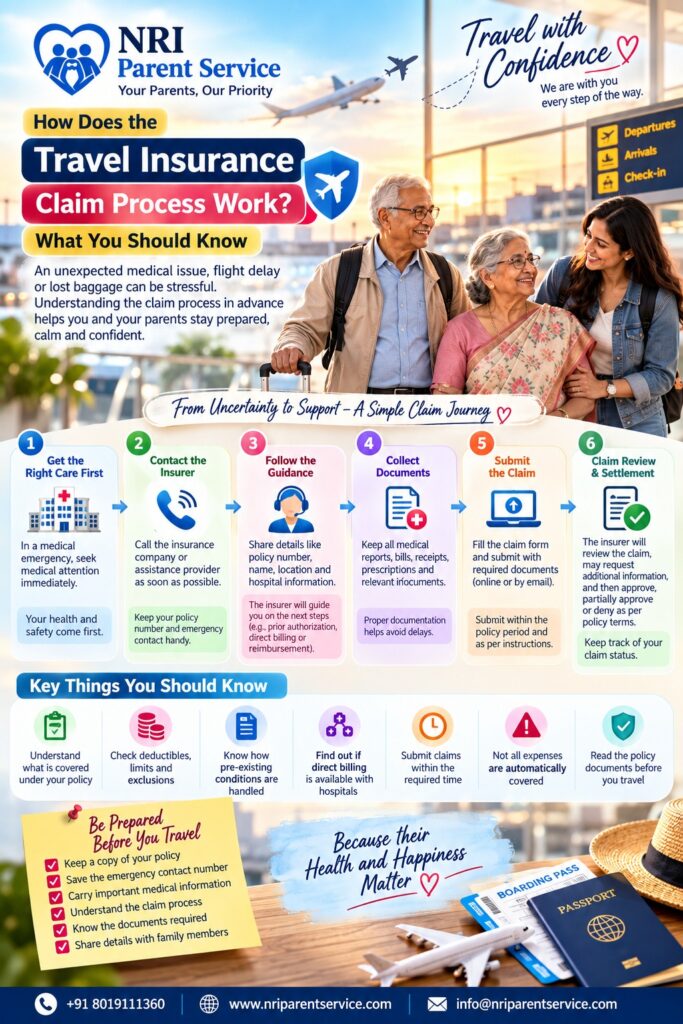
If a medical situation occurs, contact the insurance provider or assistance service as soon as reasonably possible and follow the instructions provided.
Parents should also keep copies of medical bills, prescriptions, diagnostic reports, receipts, and other relevant documents, as these may be required during the claims process.
11. Always Provide Accurate Information
When purchasing travel insurance, provide accurate information about your parents’ age, travel dates, and any information requested about their medical history.
Never assume that withholding information will make the policy cheaper or provide better coverage.
Insurance policies have specific terms and conditions, and claims are assessed according to those terms.
Being transparent at the time of purchase can help avoid unnecessary complications later.
12. Think Beyond the Price
For an NRI, arranging insurance for parents is ultimately about peace of mind.
The cheapest policy may not always be the most suitable policy. Instead of asking only, “How much does it cost?”, also ask:
“What protection will my parents receive if something unexpected happens?”
Look at the coverage, deductible, exclusions, policy maximum, age eligibility, pre-existing condition provisions, and claims process before making your decision.
Final Thoughts
When parents travel abroad, every NRI wants them to have a safe and memorable journey.
Travel insurance should therefore be considered an important part of travel planning rather than simply an optional expense.
Before purchasing a policy, take time to understand the coverage, policy maximum, deductible, exclusions, age-related conditions, pre-existing condition provisions, effective dates, and claims process.
Most importantly, choose insurance based on your parents’ individual circumstances, destination, travel duration, and coverage requirements—not simply on the lowest premium.
At NRI Parent Service, we understand that arranging travel for parents involves much more than booking a flight. Our aim is to help NRIs understand their travel insurance options and make the process easier for their parents and families.
NRI Parent Service – Your Parents, Our Priority.
If your parents are planning to travel abroad, take the time to understand their travel insurance options before they begin their journey. A little preparation today can provide valuable financial protection and greater peace of mind tomorrow.
NRI Parent Service
Your Parents, Our Priority 💙
📞 +91 8019111360
🌐 www.nriparentservice.com
✉️ [email protected]